
Studies: GASTRO-INTESTINAL ACTIVITY OF CHIOS MASTIC
In short: Chios mastic has been valued for the digestive system since ancient times, and since the 1990s a large body of research has investigated its activity in the gut. This page summarises that research, with citations. As a food supplement, mastic contributes to the normal function of the digestive system.
Historical pharmaceutical texts referenced Chios mastic for stomach discomfort, and it has long been used in the Mediterranean and Arab world as a breath freshener and food ingredient. Modern research, much of it from universities in the region, has examined its activity in the digestive system — summarised below by topic.
Stomach & duodenal ulcers
Al-Habbal et al. (1984) — a double-blind trial in 38 patients with duodenal ulcers compared mastic (1 g/day, 20 patients) with a lactose placebo (18 patients) over 2 weeks. The authors reported symptom relief in 80% of the mastic group vs 50% of placebo, and endoscopic healing in 70% vs 22%, with no side effects.
Al-Said et al. (1984) — in rats, oral mastic (500 mg/kg) reduced gastric mucosal damage and free acidity; the protective effect was absent when given intraperitoneally.
Gabr (1997) — in rats, combining mastic with indomethacin delayed the drug’s dissolution, sustained its absorption, and reduced indomethacin-induced ulceration.
Helicobacter pylori
Huwez et al. (1998, NEJM) — tested mastic against H. pylori and reported that it killed the bacteria in vitro, with structural changes to the cells.
Marone et al. (2001) — reported a bactericidal effect, with 50% of strains killed at 125 µg/ml and 90% at 500 µg/ml.
Bona et al. (2001) — reported 50% of clinical H. pylori isolates killed at 125 µg/ml.
Roe et al. (2003) — a 90-day trial in H. pylori-infected patients reported improvement in gastritis symptoms.
Paraschos et al. (2007) — in mice and in vitro, the acidic fraction and isomasticadienolic acid were the most effective at reducing bacterial colonisation.
Kottakis et al. (2008) — arabinogalactan proteins from mastic inhibited H. pylori growth and induced morphological changes.
(2009) — mastic was reported to inhibit neutrophil activation in H. pylori-infected patients, of relevance to the gastric mucosa.
Dabos et al. (2010) — reported a bactericidal effect on H. pylori in patients, with good tolerance and no side effects.
Kountouras et al. (2012) — suggested mastic may support H. pylori eradication therapy.
Miyamoto et al. (2014) — identified α-terpineol and (E)-methyl isoeugenol in mastic essential oil as the main compounds active against drug-resistant H. pylori.
If you suspect H. pylori: the first step is to test and see your doctor. You can check with an at-home stool or blood test, then confirm the result with your doctor.
Gut inflammation, Crohn’s & colitis
Kaliora et al. (2007) — reported reduced inflammation markers in patients with active Crohn’s disease.
Crohn’s immune modulation — mastic was reported to modulate immune responses, inhibiting TNF-alpha and affecting macrophage activity.
Gioxari et al. (2011) — reduced inflammatory cytokines in rats with induced colitis.
Papalois et al. (2012) — mastic and its fractions reduced inflammation in experimental colitis and regulated NF-κB signalling in human colon cells; inulin had no effect.
IBD clinical trials — reported reductions in inflammatory markers, with anti-inflammatory and prebiotic effects. See our overview of mastic and IBD.
Other digestive findings
Heo et al. (2006) — mastic oil protected rats from gut damage and bacterial translocation caused by diclofenac (an NSAID).
Hassan (2009) — mastic showed inhibitory effects on intestinal enzymes such as invertase, maltase and lactase.
Dabos et al. (2010) — in patients with functional dyspepsia, mastic was reported to improve symptoms such as stomach pain and heartburn.

Full bibliographic references are listed on our used-literature page.
Frequently asked questions
Has mastic been studied for stomach ulcers?
Yes — some clinical and animal studies have investigated mastic in relation to ulcers. However, mastic is a food supplement, not a treatment for ulcers; if you have an ulcer, see your doctor.
What does research say about mastic and Helicobacter pylori?
Several laboratory and clinical studies have investigated mastic’s activity against H. pylori, including drug-resistant strains. Mastic is not a treatment for H. pylori — if you suspect an infection, get tested and see your doctor.
Can mastic help with digestive discomfort?
As a food supplement, mastic contributes to the normal function of the digestive system. Some studies have looked at functional dyspepsia, but for persistent symptoms please see a doctor.
Want to try authentic Chios mastic as part of your routine?
Mastic for your gastrointestinal tract
-
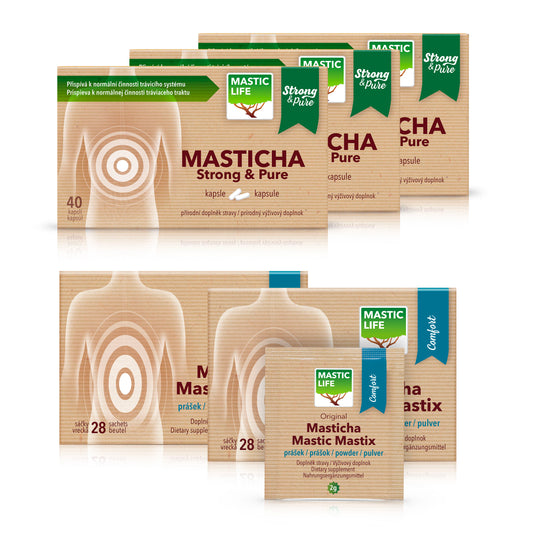 8-week treatment 🗓️
Mastic 8 weeks
Regular price 29.000 HUFRegular price36.200 HUFSale price 29.000 HUFSale -
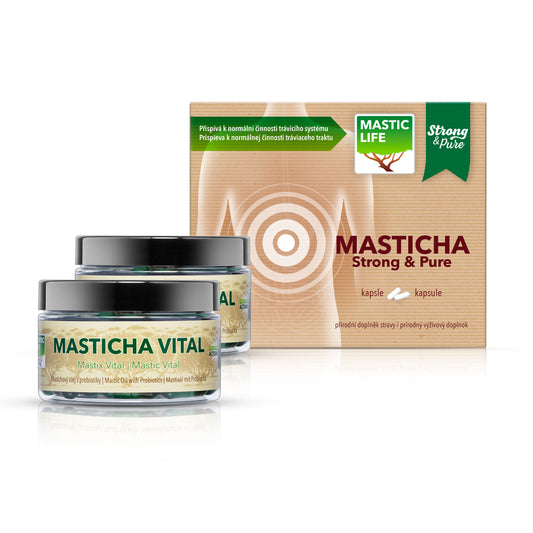 60-day treatment 💪
Mastic Gum Extra for 60 days
Regular price 48.900 HUFRegular price61.100 HUFSale price 48.900 HUFSale -
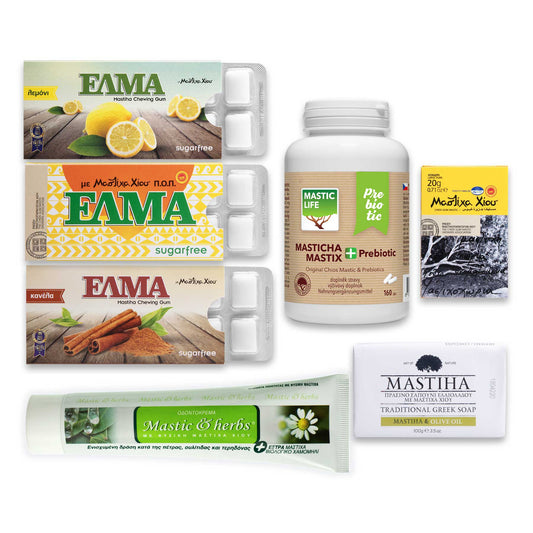 Gift set 🎁
Mastic „Life with Mastic"
Regular price 23.300 HUFRegular price26.500 HUFSale price 23.300 HUFSale -
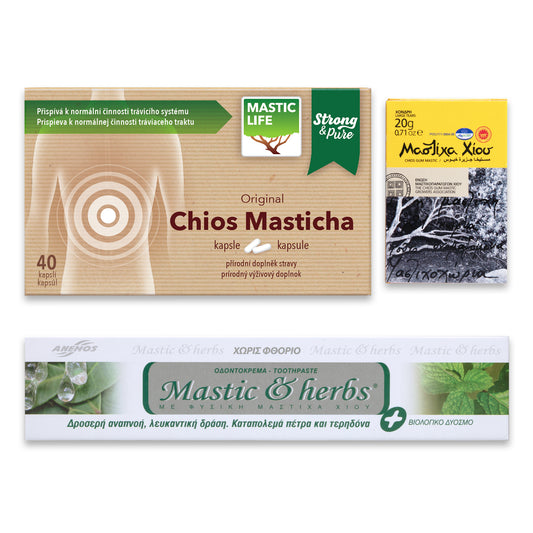 Gift set 🌿
Mastic „Pure Mastic“
Regular price 11.700 HUFRegular price12.700 HUFSale price 11.700 HUFSale
