Mastic Tree
In short: The mastic tree (Pistacia lentiscus var. Chia) is a unique evergreen. The species grows across the Mediterranean, but only the variety in southern Chios, Greece yields the prized resin known as mastic gum — the “tears of Chios”.
In this article
What is a mastic tree?
The mastic tree, known in Greek as Σχίνος (schinos), belongs to the Anacardiaceae family. In the Mastichochoria region of southern Chios, this specific variety is cultivated to harvest its natural resin — mastic gum.
Physical characteristics and appearance
- Height: typically 2–3 m, exceptionally up to 5 m.
- Growth habit: low-branching, often resembling a dense shrub.
- Leaves: dark green, oval and pointed.
- Resilience: thrives in rocky, nutrient-poor soil; shallow roots capture morning dew and humidity, allowing it to survive arid conditions.
Despite growing throughout the Mediterranean, the “tears of Chios” are produced only in the south of the island, thanks to a unique combination of soil, climate and centuries of specialised cultivation.
Growth cycle and cultivation
The mastic tree is slow-growing and long-lived, often exceeding 100 years. Key milestones:
- Full development: reached between 40 and 50 years of age.
- Reproduction: mainly by cuttings pushed into the ground in summer.
- Care: needs minimal irrigation once established; aeration and hoeing of the soil stimulate growth.
Mastic production and yield
Resin production follows a clear lifecycle:
- Initial yield: begins after the 5th–6th year.
- Peak production: after about 15 years.
- Decline: minimal after 70 years.
- Average yield: 150–180 g of raw mastic per tree per year (ranging from 10 g to 500 g).
Growers typically favour male trees for resin harvest, and proper spacing between trees is essential for air circulation and maximum yield. You can read more about mastic cultivation and production.
Varieties of mastic trees on Chios
| Variety | Description | Quality & yield |
|---|---|---|
| Mavroschinos / Pyxari | Dark green, narrow, pointed leaves with blackened edges. | High quality and purity, lower yield. |
| Votomos | Bright green, wider, less pointed leaves. | High yield, lower quality. |
| Marouliotis / Kallimasiotis | Fleshy leaves with rounded tips. | Moderate quality and yield. |
| Platyfyllos / Pyrgousikos | Common in the Pyrgi region. | Good quality, moderate yield. |
| Livanos | Rare variety with an incense-like aroma. | Poorer quality, “burnt” scent. |
| Krementinos | The rarest variety; resin is yellowish. | Low quality, does not fully solidify. |
The Association of Mastic Growers protects all cultivated varieties to maintain genetic diversity and disease resistance, preserving the agricultural legacy of Chios.

Frequently asked questions
What makes the Chios mastic tree unique?
Only Pistacia lentiscus var. Chia, grown in southern Chios, produces the resin known as mastic gum — thanks to the microclimate and unique soil of the Mastichochoria region.
How long does a mastic tree live?
A mastic tree can live for over 100 years, reaching peak production maturity between 40 and 50 years of age.
Which part of the tree produces the resin?
The mastic gum comes from the resinous “tears” that emerge from incisions made in the bark.
What is the mastic tree called in Greek?
It is called Σχίνος (schinos). Its botanical name is Pistacia lentiscus var. Chia.
How much mastic does one tree produce?
On average 150–180 g of raw mastic per year, ranging from about 10 g up to 500 g per tree.
Continue reading
Experience the resin of this remarkable tree — authentic Chios mastic tears.
Mastic for your gastrointestinal tract
-
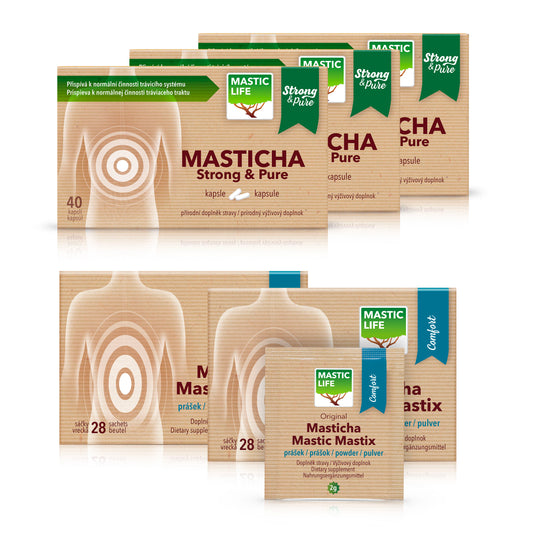 8-week treatment 🗓️
Mastic 8 weeks
Regular price 29.100 HUFRegular price36.300 HUFSale price 29.100 HUFSale -
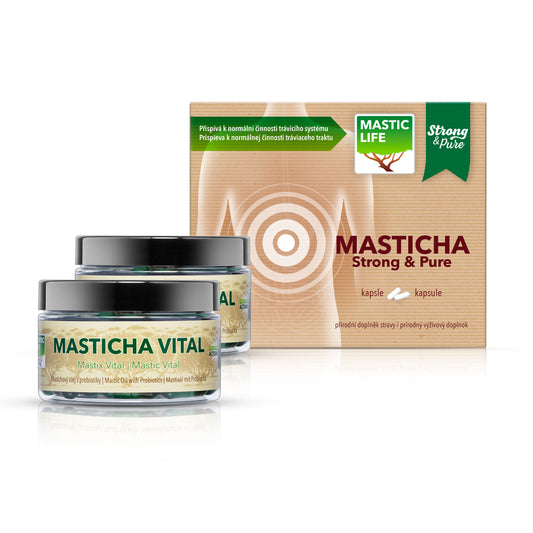 60-day treatment 💪
Mastic Gum Extra for 60 days
Regular price 49.100 HUFRegular price61.400 HUFSale price 49.100 HUFSale -
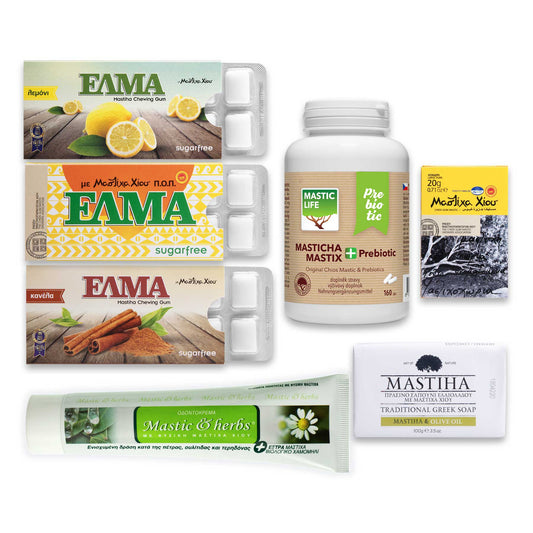 Gift set 🎁
Mastic „Life with Mastic"
Regular price 23.400 HUFRegular price26.600 HUFSale price 23.400 HUFSale -
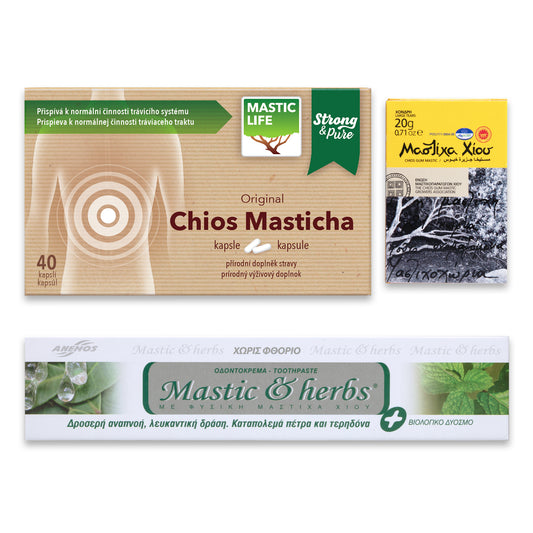 Gift set 🌿
Mastic „Pure Mastic“
Regular price 11.800 HUFRegular price12.800 HUFSale price 11.800 HUFSale
