What Is Mastic and Mastic Gum? The Tears of Chios
In short: Mastic gum (Chios mastic, Μαστίχα Χίου) is the natural aromatic resin of the mastic tree, Pistacia lentiscus var. Chia, cultivated only in the south of the Greek island of Chios. Prized since antiquity for its woody-sweet taste and pine-like fragrance, it is used in food, cosmetics and oral care — and as a food supplement it contributes to the normal function of the digestive system.
In this article
A drop of resin from the mastic tree is a phenomenon that will amaze you when you see it for the first time. It is the resin of the Pistacia lentiscus tree that grows on the island of Chios. Enjoy its unique, naturally sweet and resinous taste — and its fragrance, reminiscent of pine trees and the fruits of evergreen forests. This resin is bound up with the rich history, the culture, the particular architecture, the people and the landscape of a small area surrounded by the sea.
What is mastic?
Chios mastic (Chios Mastic Gum) is the name for the aromatic resin extracted from Pistacia lentiscus var. Chia in the southern region of the Greek island of Chios. This 100% natural product is unique in many ways. It has been valued for its properties, and its use and trade have a thousand-year-old tradition. Because of the small area under cultivation, mastic is very rare.

Mastic gum is a truly unique, all-natural substance used in a variety of ways: as an ingredient in foods and beverages, and in the cosmetic industry. As a flavouring agent it is mainly used in bakery products, confectionery, jams, ice cream, chocolate, beverages, tea and liqueurs, and as an ingredient in perfumes, cosmetic masks, toothpastes, mouthwashes, creams and food supplements (capsules and powder).
The secret of the island of Chios
Chios mastic: a “resin drop” that delights, soothes and smells! If there were a registered trademark for the island of Chios, it would certainly be the tree that produces this resin. It is a true gift of nature, which over the centuries often became a bone of contention between powerful rulers.
Mastic is the sap of an evergreen tree from the family Anacardiaceae, genus Pistacia. It grows mainly on the eastern Mediterranean coast. Of this family, only the variety Pistacia lentiscus var. Chia is systematically cultivated in the southern regions of Chios, where it produces a resin known for its distinctive character.
The combination of the tree variety, the soil, the microclimate, the topology and the relief of this area is the “secret” of the exclusivity that characterises this small corner of our planet.
PDO — Protected Designation of Origin
As an absolutely unique product linked to a specific, very small area, Chios mastic resin has been granted a Protected Designation of Origin (PDO). The PDO covers the authentic raw resin, tears and oil from Chios.
How is mastic gum extracted?
Incisions in the tree
The best-quality mastic is produced exclusively by hand, in a process that runs practically all year round. The most important and demanding phase is the notching of the bark of the trunk and the large branches during the summer months.
This natural aromatic resin is obtained in the form of drops from the notches cut with sharp tools in the trunk and large branches. The resin that flows out stays on the ground beneath the tree for about 20 days until it hardens — this depends mainly on the summer weather, above all sunlight and humidity. A fully grown mastic tree produces about 1 kg of resin per year.
Collection
The solidified raw material — the best-quality mastic — is collected from the ground beneath the tree (which is covered with white earth for this purpose) and from the trunk, then sorted by the size of the drops (also called crystals, tears or granules), which range from a few millimetres to about a centimetre in diameter. The pieces are then washed and cleaned.
Processing of the mastic gum
Processing and trade are consolidated in the Chios Mastic Growers’ Association (Énosi Mastichoparagogon Chiou), founded in 1938. Individual growers from the mastic villages transfer their entire harvest to the association’s local collector, who forwards it to the central office.
What does mastic gum look, smell and taste like?
Mastic gum is initially a clear, sticky sap that solidifies over time and takes on a yellow-brown colour. The initial bitter taste turns sweet after a few weeks. This sweetness, combined with a distinct aroma, is typical of mastic. The mature resin is characterised by a strong woody-fruity aroma and a sweet taste.
Composition of the resin
The exact composition is not yet fully known. This unique resin consists of a wide spectrum of active and aromatic ingredients. The combination of more than 80 substances probably explains why mastic is used so widely around the world.
In particular, it contains:
- natural polymers
- volatile and aromatic substances that make up the essential oil
- terpenes, phytosterols and polyphenols
- and a number of other substances, some of which were discovered here for the first time in nature
It does not contain:
- Gluten
- Listed allergens (see the allergen statement)
History of Chios mastic
Antiquity
Chios mastic has been appreciated since ancient times for its characteristic taste and qualities. Documents show that mastic was the first natural chewing gum in human history — an organic gum chewed to clean the teeth and freshen the breath. It was also used to cleanse the skin of the face and body, and appears as an ingredient in many historical creams, ointments and cosmetic waters.
Dioscorides, the father of pharmacology
Dioscorides (1st century), considered the “father of pharmacology”, divided all medicinal materials into five categories. His work “On Medicinal Materials” remained authoritative until the 16th century. In it Dioscorides praises the qualities of Chios mastic and notes that chewing it contributes to fresh breath and oral hygiene. He also mentions mastic oil and its many uses.
The early centuries
From the 1st to the 7th century, the resin from Chios is referenced by physicians such as Oribasius, Aetius and Galen for uses that, under current EU food-supplement rules, we cannot describe here.
The Middle Ages
In the following centuries many pharmacists and botanists referred to the qualities of the resin. The widespread use of Chios tears continued through the Byzantine period.
Modern times
In modern times the mastic trade flourished across Europe. Many European writings of the 16th to 18th centuries — the knowledge of the apothecaries of the time — contain extensive references to mastic.
The present
Mastic gum and its properties have been the subject of clinical and laboratory studies and of articles in international scientific journals. Since 2014, the method and know-how of resin cultivation has been inscribed on the UNESCO Representative List of the Intangible Cultural Heritage of Humanity. Each year about 250,000 kg of resin are exported from Chios, mainly to the EU, the USA, the United Arab Emirates, Saudi Arabia and Australia.
Benefits of Chios mastic
As a food supplement, mastic:
- contributes to the normal function of the digestive system;
- contributes to oral hygiene.
Beyond these roles, the European Medicines Agency (EMA) recognises mastic resin — on the basis of its long-standing traditional use — for the relief of mild digestive complaints and minor skin inflammation (HMPC assessment EMA/HMPC/46756/2015). Mastic has also attracted scientific interest: a study published in The New England Journal of Medicine examined its effect on Helicobacter pylori.
Masticlife products
The Masticlife brand brings the unique qualities of authentic Chios mastic to you in high quality.
Food supplements
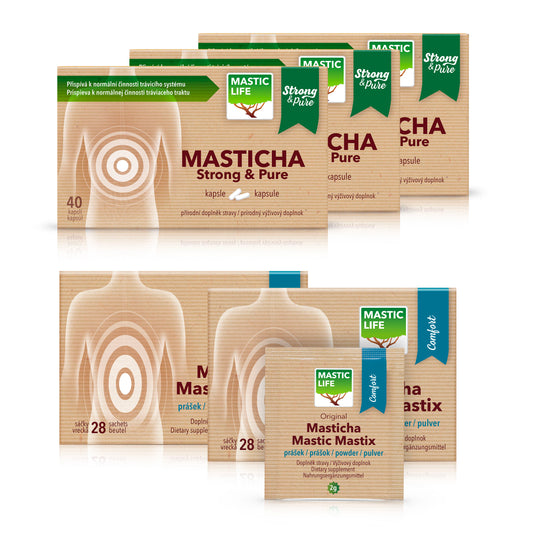
Under the Masticlife brand, authentic Chios mastic comes in several formats — from 100% pure capsules to prebiotic blends, sachets, and combinations with vitamin D3 or mastic oil. Each is a food supplement that contributes to the normal function of the digestive system, so you can pick the format that best fits your routine.
| Product | Form | What’s inside |
|---|---|---|
| Mastic Strong&Pure | Vegan capsules | 100% pure mastic gum — nothing else |
| Mastic+ Prebiotic | Capsules | Mastic gum + inulin (a prebiotic fibre) |
| Mastic Comfort | Sachets | Pure mastic gum powder (800 mg per sachet) with prebiotics |
| Mastic+ Vitamin D3 | Capsules | Mastic gum + inulin + vitamin D3 |
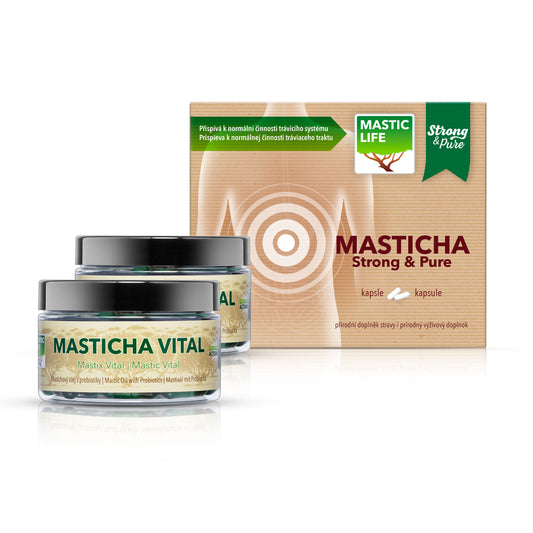
| Mastic Vital Double Action | Capsules | Mastic oil + probiotic cultures |
About the vitamin D3 version: Vitamin D contributes to the normal function of the immune system and to the maintenance of normal bones, teeth and muscles — a useful everyday addition, especially in the darker months.
Looking for a longer course or a better value? See the full supplements catalogue, including economy and multi-pack options.
Mastic gum crystals
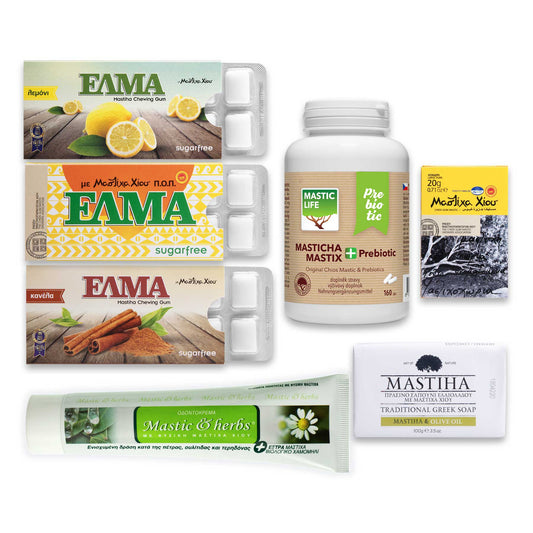
These are the raw resin tears — most often chewed like a natural gum or used as an aromatic ingredient in Mediterranean cuisine. They come in large, medium and small sizes, all available in our e-shop.
ELMA chewing gum
ELMA stands for “elliniki mastiha” — Greek mastic. These are ready-made gums with mastic and mastic oil, in sugar-free and naturally flavoured varieties. Browse the ELMA range.
Toothpastes
Toothpastes with mastic oil, for adults and children, are available in our toothpaste collection.
Cosmetics
The aromatic mastic oil is popular in hair and body care — explore soaps, creams and massage oils in our cosmetics collection.
The uses of mastic
How is mastic gum used, and for what?
- Resin — chewing gum and as a spice
- Oil — cosmetics and oral care
- Powder — food supplement
Which mastic gum product should I choose?
For the taste & the ritual
Enjoy mastic the traditional way. Start with medium-sized raw tears in a handy metal box.
Shop raw tears →For digestive support
Choose pure mastic capsules — 100% mastic gum in a vegan capsule, with no other ingredients.
Mastic Strong&Pure →For an easy daily routine
Prefer a prebiotic blend with inulin, or convenient single-dose sachets to take anywhere.
Browse supplements →Still curious about this natural wonder, or haven’t found your answer? Write to us via the contact form on the Contact page.

Frequently asked questions
What is Chios mastic gum?
Chios mastic gum is the aromatic resin from the Pistacia lentiscus var. Chia tree, grown exclusively in the southern region of Chios, Greece. It is 100% natural, with a unique flavour, aroma and a thousand-year-old tradition.
How is mastic gum harvested?
The resin is collected by hand. Growers make small cuts in the bark of the trunk and large branches during summer; the resin drips down, hardens on the ground, and is then collected, washed and sorted by size.
What are the main uses of mastic?
Mastic is used in foods and beverages, cosmetics, oral care (toothpastes and mouthwashes) and food supplements (capsules and powder). It is also valued for its distinctive aroma.
Is mastic gum a food supplement?
Yes. Mastic powder and capsules are sold as a food supplement that contributes to the normal function of the digestive system. A food supplement is not a medicine and does not replace a varied diet or medical advice.
What does mastic gum taste like?
Mastic starts as a clear, slightly bitter sap that hardens into yellow-brown tears. After a few weeks the taste turns sweet, with a distinctive woody-fruity aroma reminiscent of pine and evergreen forests.
Continue reading
Ready to discover the resin Chios has guarded for three thousand years? Start with pure capsules for digestion, or the raw tears straight from the island.
Mastic for your gastrointestinal tract
-
 8-week treatment 🗓️
Mastic 8 weeks
Regular price $87.00 USDRegular price$115.00 USDSale price $87.00 USDSale -
 60-day treatment 💪
Mastic Gum Extra for 60 days
Regular price $149.00 USDRegular price$193.00 USDSale price $149.00 USDSale -
 Gift set 🎁
Mastic „Life with Mastic"
Regular price $73.00 USDRegular price$84.00 USDSale price $73.00 USDSale -
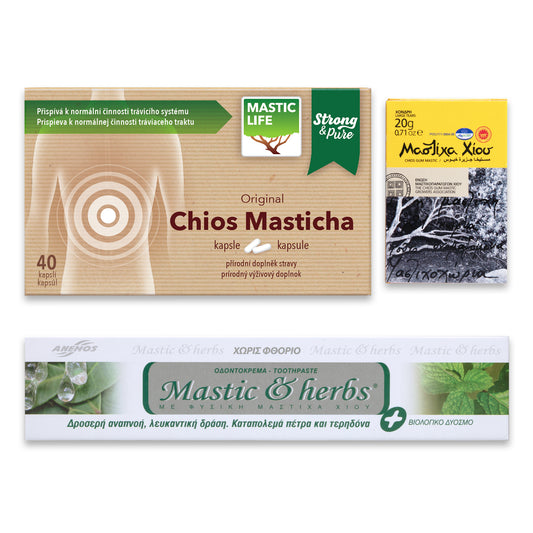 Gift set 🌿
Mastic „Pure Mastic“
Regular price $37.00 USDRegular price$41.00 USDSale price $37.00 USDSale
