
Studies: ANTIMICROBIAL ACTIVITY OF CHIOS MASTIC
In short: This page summarises published scientific research that has investigated the antimicrobial and antifungal activity of Chios mastic and mastic oil — largely in laboratory and food-preservation settings. It is provided for information and reference only.
Researchers have examined Chios mastic and its essential oil against a range of microorganisms in laboratory conditions. Historically, Abdel-Ghaffar et al. (1957) described properties of the resin in Egypt against a Bacillus subtilis-like bacterium.58 Later studies looked at the resin and oil in the context of food spoilage and foodborne organisms, with both Gram-positive and Gram-negative bacteria affected to differing degrees, and notable activity of the aqueous extract against dermatophytes in the lab.
Selected studies
Tassou & Nychas (1995)
Investigated the action of Chios mastic oil on Staphylococcus aureus, Lactobacillus plantarum, Pseudomonas fragi and Salmonella enteritidis in broth and a model food system. Gram-positive bacteria were inhibited more than Gram-negative ones.59
Ali-Shtayeh & Abu Ghdeib (1999)
Studied Chios mastic against dermatophytes (Microsporum canis, Trichophyton mentagrophytes, Trichophyton violaceum) and reported 90–100% inhibition of all three in vitro.60
Crumpet study (2004)
Examined sorbic hydroxamic acid (SHA) and mastic oil–ethanol or water-ethanol emitters on Bacillus cereus in high-moisture, high-pH crumpets. SHA, alone or with mastic-oil emitters, inhibited growth for 14 days.61
Koukoutsis et al. (2004)
Tested potassium sorbate, SHA, water-ethanol and mastic oil–ethanol emitters at various pH values against spoilage and food-safety organisms (Bacillus cereus, Bacillus subtilis, Salmonella enteritidis, Listeria monocytogenes, Saccharomyces cerevisiae, Penicillium notatum) in bakery products. Mastic-oil emitters controlled most organisms (except Listeria) for 12–28 days, with effects depending on the volatiles in the package headspace and the packaging material.62
Daifas et al. (2004)
Studied mastic resin and mastic oil, alone and with ethanol, on the growth of Clostridium botulinum and neurotoxin production in media. High levels of resin in ethanol were needed to fully inhibit all strains, and the resin showed greater anti-botulinal activity than ethanol alone; low levels of the oil were effective. Results were strain-specific.63
Koutsoudaki et al. (2005)
Analysed the chemical composition of mastic oil and gum by GC-MS (α-pinene, β-myrcene, β-pinene, limonene, β-caryophyllene). Of 12 oil components tested, verbenone, α-terpineol and linalool were identified as key contributors to antibacterial activity, which appeared to depend on the synergy of several components; sensitivity differed across Escherichia coli, Staphylococcus aureus and Bacillus subtilis.64
What the research suggests
Across these laboratory and food-science studies, Chios mastic and its oil have shown antimicrobial and antifungal activity against various organisms, with effects that depend on the form, concentration and method:
- Gram-positive bacteria (e.g. Staphylococcus aureus, Bacillus subtilis) generally appeared more sensitive than Gram-negative ones.
- Fungi and dermatophytes (e.g. Microsporum, Trichophyton) were strongly inhibited in vitro.
- Activity against foodborne organisms was often greater when mastic was combined with ethanol or used in packaging emitters.
- The effect is attributed to several resin and oil components acting together.
This is laboratory and food-preservation research; it does not describe the effects of taking a food supplement.

References
- Abdel-Ghaffar A.S., El Nawawy A.S., Mohamed M.S. (1957). The inhibitory effect of mastic gum on bacterial growth. Alex. Med. J., 3: 119–124.
- Tassou C.C., Nychas G.J.E. (1995). Antimicrobial activity of the essential oil of mastic gum (Pistacia lentiscus var. chia)… Int. Biodeter. & Biodegr., 36(3): 411–420.
- Ali-Shtayeh M.S., Abu Ghdeib S.I. (1999). Antifungal activity of plant extracts against dermatophytes. Mycoses, 42: 665–672.
- Koukoutsis J. et al. (2004). Control of Bacillus cereus in high-pH crumpets. J. of Food Safety, 24: 309–324.
- Koukoutsis J. et al. (2004). In vitro studies to control the growth of microorganisms… in high-moisture, high-pH bakery products. J. of Food Safety, 24: 211–230.
- Phillips Daifas D. et al. (2004). Effects of mastic resin and its essential oil on the growth of proteolytic Clostridium botulinum. Int. J. of Food Microb., 94(3): 313–322.
- Koutsoudaki C., Krsek M., Rodger A. (2005). Chemical composition and antibacterial activity of the essential oil and the gum of Pistacia lentiscus var. chia. J. Agric. Food Chem., 53: 7681–7685.
Discover authentic Chios mastic for yourself.
Mastic for your gastrointestinal tract
-
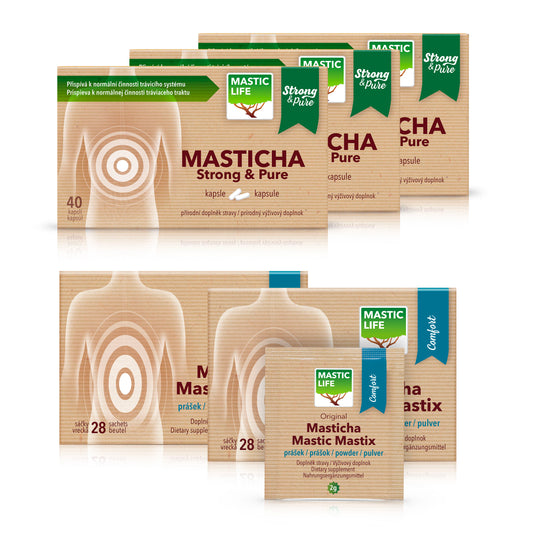 8-week treatment 🗓️
Mastic 8 weeks
Regular price $90.00 USDRegular price$112.00 USDSale price $90.00 USDSale -
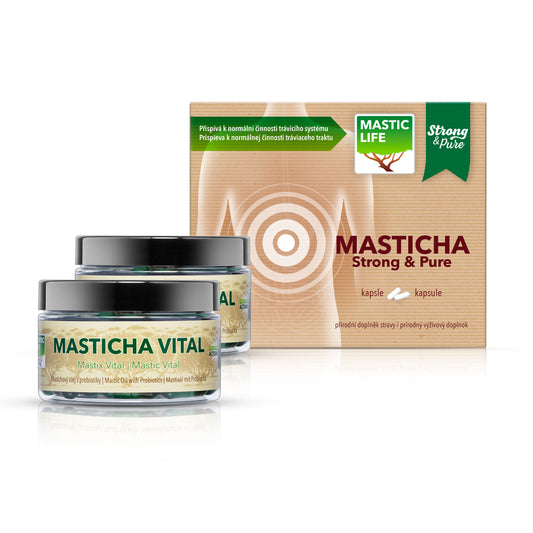 60-day treatment 💪
Mastic Gum Extra for 60 days
Regular price $151.00 USDRegular price$189.00 USDSale price $151.00 USDSale -
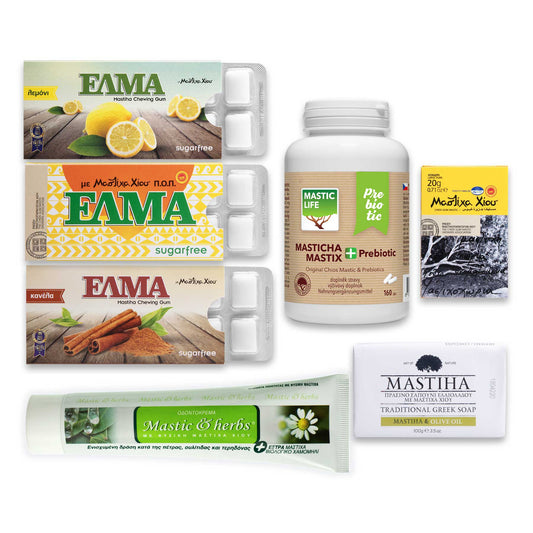 Gift set 🎁
Mastic „Life with Mastic"
Regular price $72.00 USDRegular price$82.00 USDSale price $72.00 USDSale -
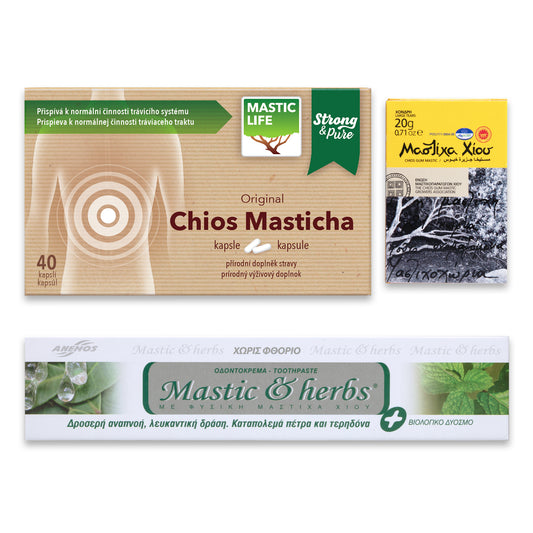 Gift set 🌿
Mastic „Pure Mastic“
Regular price $37.00 USDRegular price$40.00 USDSale price $37.00 USDSale
