
Mastic: Cultivation and Production
In short: Chios mastic is grown and harvested by hand in the Mastichochoria of southern Chios. After year-round tree care, growers make small summer incisions in the bark; the resin drips out, hardens into “tears” over 10–20 days, and is hand-collected, cleaned and sorted — a process barely changed in 500 years.
In this article
The cultivation of mastic trees and the production of mastic is concentrated in a small area in the south of Chios — the Mastichochoria (mastic villages). The whole production is strictly organised.
The Association of Mastic Growers
All mastic production is organised within the Chios Gum Mastic Growers Association (Énosi Mastichoparagogon Chiou). Established in 1938 as the sole administrator of this unique natural product in Greece and abroad, it unites all mastic-tree owners in a cooperative — currently around 4,500 members.
The Association organises and supervises cultivation, buys the harvest, provides subsidies, and ensures the processing and packaging of the raw material. It also invests in research and new products. Centralised processing guarantees consistent quality and uniform sorting for direct consumption, powder for Masticlife food supplements, oil, and more complex products such as ELMA chewing gum, cosmetics and food.
The year-round care of the trees and the careful preparation for harvest is a family affair for the owners and tenants of the mastic groves.

Care of the mastic trees
Manuring
Growing mastic is a year-round job, and the older the tree, the more care it needs. Usually in December, growers begin manuring the trees with natural fertiliser — including the trees’ own fallen leaves — and use green manure to supply nitrogen.
Pruning
Mastic trees are pruned annually and cleared of dry branches, with a more extensive cut roughly every five years. In mid-January and February the crowns are shaped so the tree gains the ideal form for light and air circulation.
Plantations
Maintaining the groves means propagating new trees, done by cuttings — usually in February and March (sometimes autumn). Medium to weaker branches are cut to about half a metre, stripped of shoots and foliage over three-quarters of their length, and laid lengthwise in furrows 20–50 cm deep, spaced 3–4 m apart. Spring cuttings need irrigation; autumn cuttings rely on natural moisture and winter rains.
Mastic collection
Preparatory work
From mid-June into July, the soil around each trunk is cleaned and levelled in neat circles so the dripping resin can be collected easily. The prepared ground is then dusted with white limestone powder, spread into a smooth, bright surface — the final step before harvest, leaving the groves immaculately clean.

The first cut
Kentos — the small incisions in the bark — is the most important stage of production. Made in July and August (sometimes into September) with a sharp-pointed tool called a kentitiri and a small hammer (sfiraki), the notches are about half a centimetre wide and 10–15 cm long, running slightly obliquely up the trunk and main branches. They are made gradually over up to six weeks, usually in the morning.
Resin flow and solidifying
The resin runs from the notches and begins to solidify, falling onto the prepared ground or staying on the branches. The drops harden 15–20 days after the first incision — in a colder year, as little as 10 days.
The first collection
First, the large pieces — the pítes — are collected, and resin is scraped from the branches and trunk. Smaller pieces are swept into a pile or gathered by hand. The mastic is then stored in wooden crates in a cool place and thoroughly cleaned, ready to be handed over.

Second cut and collection
After 15 August (the feast of the Virgin Mary), the whole cutting process is repeated, with the second collection beginning after mid-September.
Mastic processing
The collected mastic is stored in cool places in the growers’ homes, where the following weeks and months are devoted to careful sorting and cleaning — the quality of this work determines the purchase price paid by the Association.
The entire harvest then goes to the Association’s cold warehouses and production halls, where the mastic is cleaned again in several stages, sorted into three sizes and packaged for sale or further processing. The site also includes a mastic-crushing line, and the nearby ELMA factory produces chewing gum.
The Association compiles a public overview of total production sorted by type and size — large, medium and small pieces — alongside ELMA chewing gum, mastic oil and mastic powder.
A process unchanged for ages
The cultivation and production of mastic on Chios has barely changed since ancient tradition:
- Some practices have been gently streamlined — but only by refining ancestral experience.
- Cleaning and sorting is partly done by machine, yet it remains a purely mechanical process.
- The tools have softer padding, but in principle they are the same as 500 years ago.
The only thing that might surprise a visitor from the past is an electric blower for cleaning the soil under the trees. Not only the mastic itself, but also the way it is obtained, endures through the ages.
Step-by-step summary
| Stage / step | Description |
|---|---|
| Cultivation area | Southern Chios, the Mastichochoria; the entire production is strictly organised. |
| Association of Mastic Growers | Established 1938; manages cultivation, purchase, subsidies, processing and R&D; ~4,500 members. |
| Manuring | December: natural fertiliser and green manure; older trees need more care. |
| Pruning | Annual pruning of dry branches; extensive cut every ~5 years; done Jan–Feb. |
| Propagation | Cuttings planted Feb–Mar (or autumn) in furrows 20–50 cm deep; spring irrigation. |
| Soil preparation | Mid-Jun to Jul: clean and level the soil, dust with white limestone. |
| First cut (kentos) | Jul–Aug (sometimes Sep): incisions ~0.5 cm wide, 10–15 cm long; made gradually over six weeks. |
| Resin flow & solidifying | Resin drips and hardens on soil or branches in 10–20 days, depending on temperature. |
| First collection | Collect large pieces (pítes), scrape branches and trunk, sweep smaller pieces, store in crates. |
| Second cut & collection | After 15 Aug; process repeated, second collection from mid-Sep. |
| Processing & sorting | Cleaned in stages, sorted into three sizes, packaged for sale or further processing. |
| Quality control | The Association ensures consistent quality, uniform sizing and public production statistics. |
Frequently asked questions
How is Chios mastic harvested?
Growers prepare the soil, then make small incisions (kentos) in the bark during summer. The resin drips out, hardens into tears over 10–20 days, and is collected by hand, cleaned and sorted.
Why is white powder spread under the mastic trees?
It is white limestone powder, spread on the cleaned soil so the dripping resin stays clean and is easy to collect.
How long does mastic take to solidify?
The drops harden about 15–20 days after the first incision — in a colder year, as little as 10 days.
Who manages mastic production on Chios?
The Chios Gum Mastic Growers Association, established in 1938, with around 4,500 members.
Continue reading
Taste the result of this centuries-old craft — authentic Chios mastic tears, sorted by size.
Mastic for your gastrointestinal tract
-
 8-week treatment 🗓️
Mastic 8 weeks
Regular price $91.00 USDRegular price$113.00 USDSale price $91.00 USDSale -
 60-day treatment 💪
Mastic Gum Extra for 60 days
Regular price $153.00 USDRegular price$191.00 USDSale price $153.00 USDSale -
 Gift set 🎁
Mastic „Life with Mastic"
Regular price $73.00 USDRegular price$83.00 USDSale price $73.00 USDSale -
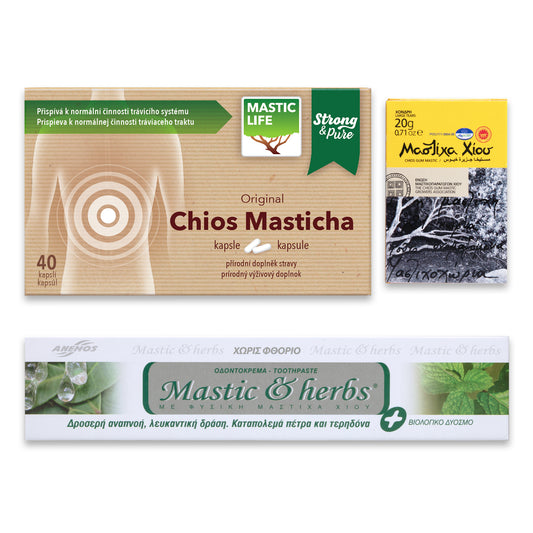 Gift set 🌿
Mastic „Pure Mastic“
Regular price $37.00 USDRegular price$40.00 USDSale price $37.00 USDSale
