
Pyrgi: The Painted Mastic Village
In short: Pyrgi is the largest — and for many the most important — medieval village on Chios. It's admired for its well-preserved fortress architecture and, above all, for the striking black-and-white geometric "Xysta" patterns that cover its house facades.
In this article
Pyrgi: the painted village
The village of fewer than a thousand inhabitants, about 25 km south of the capital, takes its name from the massive defensive tower (pyrgos in Greek) that once dominated it. Pyrgi was built on the model of medieval fortress architecture, first applied to large monasteries. This defensive system protected the villagers and their wealth from raids by pirates and other enemies. The original perimeter walls of the village and its four corner watchtowers can still be seen today.
There were only two gates into the original walled village: the Lower Gate to the east and the Upper Gate to the west, always closed in the evening and in emergencies. The houses on the edge of the village had no windows or doors on the outside, forming an impenetrable wall.
At the centre stood a massive tower — the defensive and administrative heart of the village, built in the Genoese period. Its entrance sat several metres above the ground, reachable only by a pull-up ladder — a clever way to protect the inhabitants, who could take refuge there in danger. The tower was about 18 metres high, but only the foundations survive: it was badly damaged in 1881, and in 1937 the villagers decided to demolish it completely.
Pyrgi at a glance
| Category | Details |
|---|---|
| Population | Fewer than 1,000 inhabitants |
| Location | About 25 km south of Chios town |
| Settlement type | Medieval fortified village |
| Historic features | Central tower (pyrgos), original walls, 4 corner watchtowers, 2 gates (Lower & Upper) |
| Churches | Byzantine Church of Agii Apostoli, with frescoes |
| Houses | Stone, two-storey, with internal staircases and roof "bridges" |
| Xysta | Geometric plaster designs (triangles, diamonds, circles) made with black sand on white plaster |
Churches
On the village square, the Byzantine Church of Agii Apostoli has preserved exquisite frescoes inspired by themes from the Old and New Testaments. The presence of such a grand church suggests the village's origins do not trace back only to the Genoese; rather, certain neighbouring settlements were absorbed into the pre-existing village during the Genoese occupation.
Houses
All the original medieval houses were two-storey and built of stone, as protection against fire. Their interiors were similarly arranged: the ground floor — the shadiest part — held larders, food stores and stables for animals, while an internal staircase led up to the living quarters. The houses were of similar height and, in many places, connected by a "bridge" across the street, so inhabitants could move around the village even across the rooftops.
Xysta
In Pyrgi, visitors encounter a distinctive form of ornamentation on the house facades. Xysta are intricate designs etched into plaster — unparalleled in Greece and remarkably striking. The patterns use simple shapes: triangles, diamonds, circles and semi-circles. The technique is based on scraping black sand over meticulously whitened plaster, so black geometric patterns stand out on a white background. Xysta decorate the walls of both churches and houses, leaving a bold and unexpected impression.

Mastic for your gastrointestinal tract
-
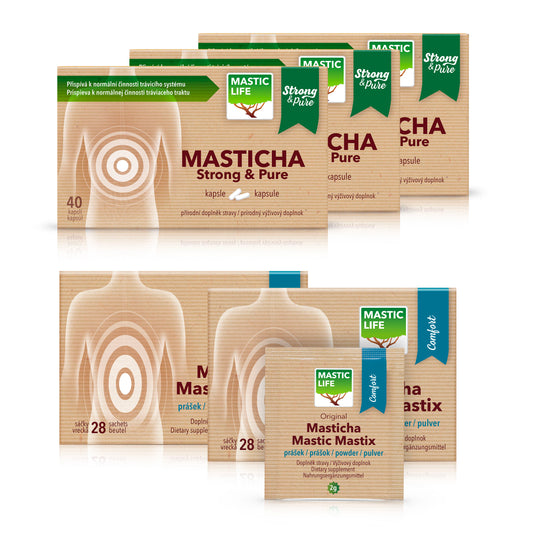 8-week treatment 🗓️
Mastic 8 weeks
Regular price $90.00 USDRegular price$112.00 USDSale price $90.00 USDSale -
 60-day treatment 💪
Mastic Gum Extra for 60 days
Regular price $151.00 USDRegular price$189.00 USDSale price $151.00 USDSale -
 Gift set 🎁
Mastic „Life with Mastic"
Regular price $72.00 USDRegular price$82.00 USDSale price $72.00 USDSale -
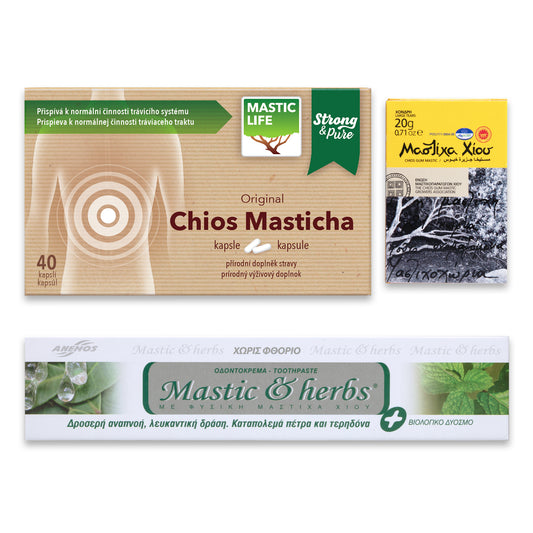 Gift set 🌿
Mastic „Pure Mastic“
Regular price $37.00 USDRegular price$40.00 USDSale price $37.00 USDSale
