
The Newest Article about Mastic Oil
“Mastic oil is a promising natural ingredient containing monoterpenes…”
In short: A human study investigated how the monoterpenes in mastic oil (α-pinene, β-pinene and myrcene) are absorbed after a single dose, and measured their effect on the antioxidant capacity of blood. This page summarises that research.
Bioavailability of mastic oil: how it interacts with the body
Mastic oil contains natural compounds called monoterpenes (α-pinene, β-pinene and myrcene). A clinical study (ClinicalTrials.gov ID NCT04290312) investigated how these compounds are absorbed after a single dose.

What the study observed
- Rapid absorption: the monoterpenes were rapidly absorbed into the bloodstream — α-pinene was detectable within 30 minutes and remained present for up to 24 hours.
- Antioxidant measure: the study measured an increase in the resistance of serum lipids to oxidation, beginning at 1 hour and peaking at 2 hours after consumption.
- Bioavailability: the data indicate that α-pinene, β-pinene and myrcene from mastic oil are bioavailable and processed by the body.
In summary, the authors concluded that the bioactive components of mastic oil are well absorbed and were associated with a measurable change in the body’s antioxidant status in this study.
Reference: Papada E. et al. (2020). An absorption and plasma kinetics study of monoterpenes present in mastiha oil in humans. Foods, 9(8): 1019 (MDPI). ClinicalTrials.gov ID: NCT04290312.
Continue reading
Want to discover authentic Chios mastic oil?
Mastic for your gastrointestinal tract
-
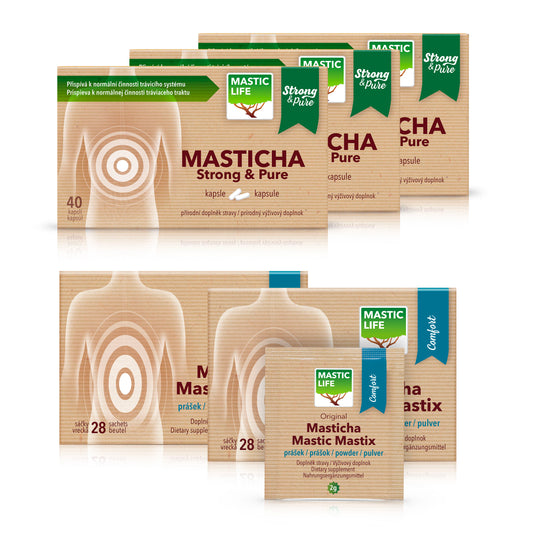 8-week treatment 🗓️
Mastic 8 weeks
Regular price €78.00 EURRegular price€97.50 EURSale price €78.00 EURSale -
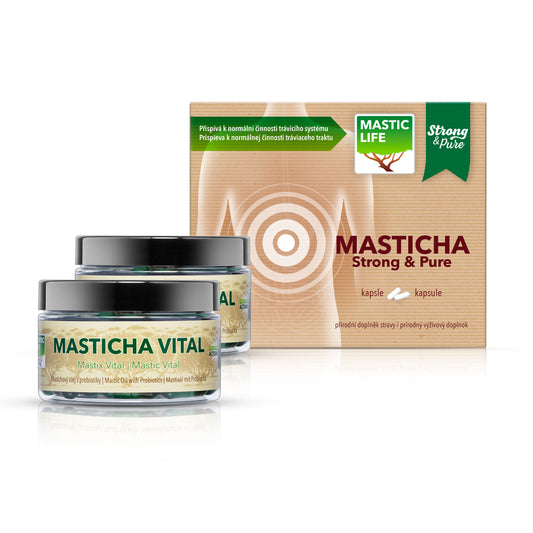 60-day treatment 💪
Mastic Gum Extra for 60 days
Regular price €131.80 EURRegular price€164.70 EURSale price €131.80 EURSale -
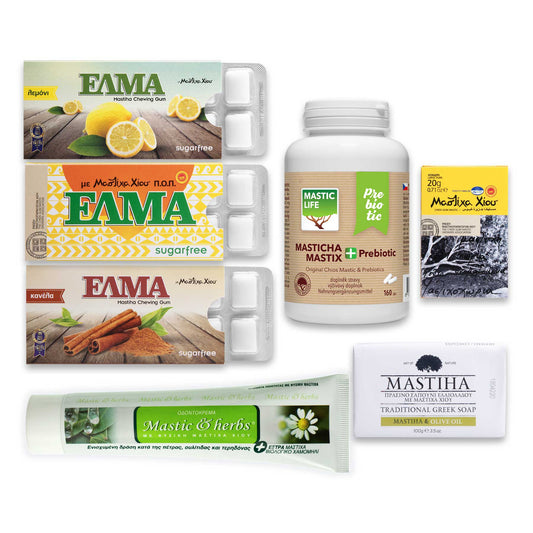 Gift set 🎁
Mastic „Life with Mastic"
Regular price €62.70 EURRegular price€71.30 EURSale price €62.70 EURSale -
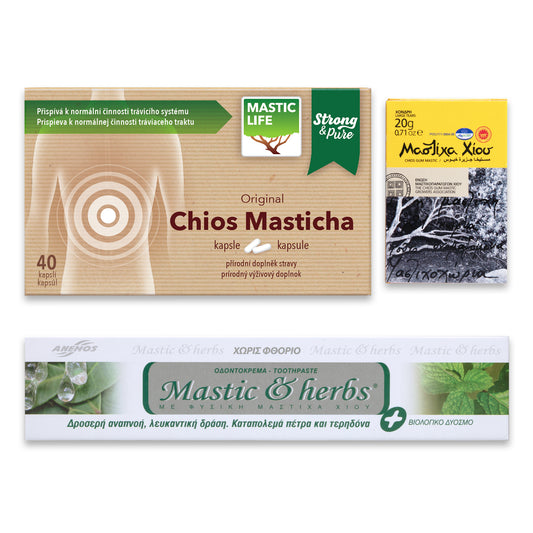 Gift set 🌿
Mastic „Pure Mastic“
Regular price €31.50 EURRegular price€34.20 EURSale price €31.50 EURSale
